Forge of Darkness
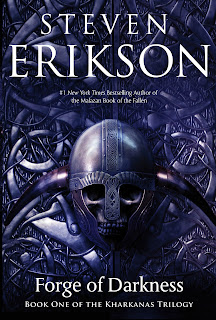 You all know how big a fan I am of Steven Erikson. He single-handedly changed my views on the Fantasy genre, and he has written some of my favorite novels. Ever. When people ask who my favorite authors are, the first one I always say is Steven Erikson.
All that said, I'm a reviewer. I understand why people don't like his work. That's fine. Not everyone reads and likes the same things, and that is how the world of literature should be. But I would be lying if I said it didn't make me a tad disappointed whenever someone says they just couldn't "get into" Erikson's Malazan series. There are so many unbelievable characters in that series, and the stories of the rise and fall of entire civilizations are spectacular.
FORGE OF DARKNESS, the first novel in Erikson's Kharkanas Trilogy, was the novel I hoped would bring in all those readers who wanted a different starting point to Erikson's work. It is a prequel to the Malazan Book of the Fallen 10-novel epic, and it both succeeds and fails.
I'll start with appealing to those of you who, like myself, have read the full Malazan series. Did you ever want to know more about Anomander Rake? How about Silchas Ruin and Andarist? Draconus maybe? Perhaps Caladan Brood? I've always wanted more info on Mother Dark. I'm hardly scratching the surface here, but can you see why the prospect of a novel following all these individuals could be so dang exciting?
Here is the description from Amazon:
It's a conflicted time in Kurald Galain, the realm of Darkness, where
Mother Dark reigns. But this ancient land was once home to many a power.
and even death is not quite eternal. The commoners' great hero, Vatha
Urusander, is being promoted by his followers to take Mother Dark's hand
in marriage, but her Consort, Lord Draconus, stands in the way of such
ambitions. The impending clash sends fissures throughout the realm, and
as the rumors of civil war burn through the masses, an ancient power
emerges from the long dead seas. Caught in the middle of it all are the
First Sons of Darkness, Anomander, Andarist, and Silchas Ruin of the
Purake Hold...
From the instant I opened the book and read the opening, I knew I was reading an Erikson novel. His style is so distinct, and his writing beautiful even when describing the most horrible things. It was interesting to see such a different view-point on the Tiste, and specifically on the Sons of Darkness. Anomander became one of my favorite characters in all of fiction when I first read GARDENS OF THE MOON those many years ago. I couldn't help but feel giddy when he made his first appearance in FORGE OF DARKNESS. The feeling was equally strong when Draconus showed up.
And then we don't really get much of them in the rest of the novel.
Yeah. I kept waiting for the next chapter to get back to those men who would become giants in the Malazan series, but it kept getting postponed by the PoVs of a dozen other characters (who also go on to have roles in the Malazan series). At first, this bugged me--and it is something you should be aware of as a reader--but once I stopped focusing on what I was expecting through preconceived notions of what the book should be about, I was able to focus on what the novel was actually about.
Every story starts somewhere. Much of what makes the Malazan Book of the Fallen awesome has its roots in the Kharkanas Trilogy. So many of the characters in that 10-book epic are so tough, so incredible, and being able to see them in a much younger stage of development was extremely rewarding. I was struck how it served as a form of reverse character development. Many times we got such a limited view of the characters in The Malazan Book of the Fallen, or we saw them at their zenith. Now, finally, we see the decisions that led to the consequences in GARDENS OF THE MOON and beyond.
Now, FORGE OF DARKNESS isn't all roses. While I ended up really liking the side characters, I noticed one thing about all of them that really began bothering me towards the latter portion of the novel. Erikson really likes his characters to have philosophical discussions. In other novels, Erikson would limit this to certain PoVs. Not so here. I swear that every character--man, woman, child, Tiste, horse, Jaghut, soldier, corpse, or dog--took a moment to delve into a deep discussion on random bits of philosophy. I like certain characters to go that route, but not ALL of them. It's like how I often point out how Brandon Sanderson makes all of his characters overly witty in a few of his books. I like it a little bit, but not with everyone. Heck, remember Karsa? There came a point where even he says, "Enough talk. Witness."
Lastly, after the initial cool factor of seeing your favorite characters for the first time, the novel slows WAY down. It's mostly talking, even at the end. We get a few battles, but no "convergence" clashes of epic magnitude. I appreciate the political manipulations that pervade the novel, but there comes a point where the pace needs to be picked up. Hopefully we will see this in book 2.
The end result of all of this is that FORGE OF DARKNESS is an incredible novel for a fan of Erikson's work. I'm that guy. I loved it. But as a reviewer, and as a guy that wants more people to read Erikson's work, I can't help but feel it was a missed opportunity to pull in even more new readers.
FORGE OF DARKNESS is an incredible novel, but my opinion is that you shouldn't start here. You should start with GARDENS OF THE MOON just as before. If you are already a fan, this book is a must-read. And as ever, I look forward to the next Erikson novel.
Recommended Age: 17+
Profanity: More than usual. It can be strong, but not distracting.
Violence: When Erikson cuts loose, it is violent and awesome. It can also be very, very grim and disturbing. This is probably the most personally violent novel he has written.
Sex: Far more than normal. There are frequent mentions of rape, and a couple of characters have a very sexual relationship. It never gets crazy explicit, but it is far more detailed than in any of his previous work.
Pick it up here:
FORGE OF DARKNESS
Interview with Steven Erikson
 Do you faithful readers want to know the absolute best part of this whole book review blog thing? Author interviews. Just being able to get a few minutes of an author's time to ask him or her those questions burning in our minds. It's completely fantastic. What makes it even better is when we get to interview one of our absolute favorite authors, and he is completely open and honest in his answers. Steven Erikson falls in this category for us. The guy completely blew us away with his writing, and then outdid himself with his humble answers to our questions.
***The Interview***
Elitist Book Reviews: Steven, thank you so much for chatting with us for a few minutes. We want to start off by giving you a few moments to brag a bit. What do you think makes your series so great?
Steven Erikson: If I was to brag about this series I would have missed the whole point of my own series, which would be a bad thing. For me writing is an exercise in humility. It always astonishes me when I prowl the hate-box (funny how the internet was meant to be a love-box, only to have it increasingly sway in the opposite direction … well, not funny. Disturbing) and read from fans of the genre comments on my coming across as arrogant, either in interviews or in my fiction. For my own sanity I can only assume that by subverting the tropes of the genre in my fantasy fiction, I am somehow perceived as attacking the lovers of the genre, which I am emphatically not doing. I grew up reading and loving the same stuff they’re now reading: but as a writer I wanted to twist it a little, do something different, and avoid the lazy route of reiterating what other writers have already done. This has landed me in the occasional shit-storm, where fans in their tribes feel it necessary to put down other writers in order to build up their favorite writers. Uhm, it’s not a competition, mates, and when I’m being judgmental, it’s self-directed. As writers we each participate to make up the whole genre, and it’s a big, flexible genre. For myself, I do hope that fans of my work read and enjoy as much fantasy fiction as is out there, and to forever remain open to new voices; and, most importantly, to not feel threatened by new takes on the genre. You lose nothing by being open-minded and you lose everything when you shut the door, bolt the lock, and hide from every challenge.
Your question alarms me in that you assume that I feel my series is great. That’s for readers to decide, not me. I did the best I could, with what talents I possess. It’s done, it’s out there. Maybe it’ll swim, maybe it’ll sink.
EBR: THE CRIPPLED GOD is out—and it is fantastic. It’s been a long and epic ride. What kind of emotions are you feeling with the conclusion to this ten-book portion of the story?
Erikson: Exhausted, emptied out, relieved. In The Crippled God I was writing towards scenes I had imagined in my head for nearly a decade. The pressure was immense; in fact, this whole series has been written with that pressure. It was a huge series, written out of heart-break, and for me it was a long, drawn-out search for hope. When it was done, I felt numb. Didn’t write a word for six weeks – my longest drought ever as a professional writer.
When I am asked for advice by beginning writers, I always say ‘finish what you start,’ and it turns out that advice was as applicable to me as to them. I finished what I started and that is a good feeling indeed. In fact, it’s the real reward to all this, because it means that you can walk away, head held high – and I recommend it to everyone, in all endeavors you may undertake.
EBR: What was the most difficult part of writing this series? What was the most enjoyable part?
Erikson: I suppose the most difficult part of writing this series was sticking to my guns, from start to finish. I’ve taken a lot of hits, book after book; and while there has been appreciation from fans it’s often the case that the vitriol cuts through to leave a bitter taste, while the praise washes off. In the end, comments from others, both positive and negative, only reach in so far. The core of desire remains inviolate, but it’s taken a beating at times. The most enjoyable part follows on from this, in that I didn’t waver, or give up, or lose interest, and now that it is done I can look back and, barring a frenzy of book-burning worldwide, the series is out there, done, and will remain for as long as readers enjoy it.
EBR: What is the area of your writing that has improved the most?
Erikson: I don’t know, to be honest. I’m not afraid of complexity, I suppose, though in the beginning I wasn’t about to let my fear stop me, so youthful stubbornness and brazen determination has given way to bemused faith in the process. I guess I learned to trust myself.
That said, writing is not about opinions, not about answers, not about solutions. It’s just a way of searching, and people either come along with you in that search, or they don’t. Used to be I tried to write as inclusively as I could, but really, it never worked for me. I long ago gave up on the notion of universal adoration, and for all my supposed brilliance, I’d still fail Grade Eight math. Now, before that gets quoted out of context (as if I can stop that), no, I don’t suppose I am brilliant. If I have virtues pertaining to all this, they are all double-edged. Patience with stubbornness; ambition with crushing doubt … the usual crap, mostly. In the end, we’re all mirrors to each other. Call me names at your peril.
EBR: Your novels are large. Door-stop sized even. How is it that you have been able to keep such a firm and consistent release schedule in a day where huge delays have seemingly become the norm?
Erikson: As you might glean from my answers to the questions thus far, what kept me going was desperation. I needed to get this damned thing done, if only to discover what the world was like once the series was behind me. There’s a poem in The Crippled God, to open the epilogue, that pretty much sums it up, as it addresses both my core belief and my core uncertainties. It was written in that closing moment of exhaustion, both physical and spiritual, when the only voice left is an honest one.
EBR: Your co-creator, Cam, has improved in his craft dramatically from book to book. What makes him such a good compliment to your own style and your own writing?
Erikson: From the very beginning, in creating this world via roleplaying, it was always an even exchange. I made up characters who interacted with his storylines, and he did the same with his characters acting in my storylines, so everything in the Malazan world has both of us in it. It’s the same when we get together in person: no matter how much time we’ve spent apart, living our own lives, we immediately fall back into that comfort of friendship and shared vision.
It just sort of happened that we ended up meeting on an archaeology dig, spent a few summers working together in the wilds of Northern Ontario (living in the town of Neil Young fame, helpless and hopeless indeed), and became lifelong friends in the years that followed.
You’ve all had this in your lives, I’m sure. The friend who, no matter the distance in miles or years, can just step in time with you the moment you reunite. That said, we’ve been through a lot of stuff together, me and Cam; in many ways, we still write to an audience of one, that one being each other. We’re in conversation, via our novels. It was always a conceit that anybody else would be interested in that conversation. Luckily, a few people were, and are.
EBR: Is there anything you wish you could have done differently since becoming a published author?
Erikson: These kinds of questions are almost impossible to answer. I wish I could have become a full-time writer about ten years before I did: I worked a lot of jobs, some of them soul-destroying; and we spent years being dirt poor (it didn’t help that I grew up poor as well) … but if that had happened, would I be the same writer? Would I have written the same stuff? Who knows. I’m just thankful for what I have.
EBR: The Malazan Book of the Fallen has come to a close, but you have other Malazan tales in the works. What should the masses look forward to in the coming years?
Erikson: I have signed for two more trilogies. The first one (which I’ve already begun) takes us back into the distant past in the Malazan universe. Once that’s done, I will be picking up the tale of Karsa Orlong in the second trilogy. If I can, I will write some other stuff as well, including more novellas and non-Malazan tales.
EBR: Again Steven, we are so thrilled that you were able to chat with us for a bit. Any parting words for our readers, and can we expect to see you at any conventions in the near future?
Erikson: I enjoy conventions and have a few I regularly attend, though I am always open to new ones, depending on my schedule.
Parting words to your readers? Be well, be kind, unwind…
Cheers
The Crippled God
 It's hard to know where to begin with this review. I've been reading Steven Erikson's The Malazan Book of the Fallen for six years. It's what got me re-interested in fantasy after years toiling under the belief that fantasy was imprisoned in the land of elves and dwarves. Six years.
And suddenly here we are at the end.
THE CRIPPLED GOD (TCG). The tenth and final novel in The Malazan Book of the Fallen. I'd be lying if I said I never had a moment of worry going into this novel. Up until this point, Erikson's series has been one of the standards to which I compare all modern fantasy. Many authors have enough trouble simply writing the ending to one novel, never mind the final book of a ten novel series. The short version is that TCG blew me completely away.
I recently read a review of TCG by Bill Capossere over at Tor.com. It is a fantastic review that you all should read. It also was nearly identical to a review I was excited to post. So yeah, this is attempt number two. Bill totally preempted me (I still think he's awesome)...but you know the saying about great minds and all that. One thing I haven't adjusted from the draft of the review is a quote from TCG that essentially diagrams what the book is about. Names of the characters speaking were omitted to prevent insane spoilers:
"There are too many rogue players in this game. Icarium. Draconus. The First Sword of the T’lan Imass. Olar Ethil. Silchas Ruin, Tulas Shorn, Kilava—even Gruntle, the Mortal Sword of Treach. And now the Elient, and how many dragons have come or are coming through the gate? A hundred? A thousand? Oh, and the Elder Gods: Errastas, the past Master of the Tiles, and Kilmandaros and her son...“
“They—they’re all here?”
“Nobody said it’d be easy...what do you have to offer me?”
“Why, more good news...Let’s just add the K’Chain Che’Malle and the Jaghut, and oh...who knows how many slavering fanatics of the Wolves of Winter! And what about the Crippled God himself?”
“All right, it’s rather more complicated than I had imagined.”
Yeah. And that only touches the surface.
This novel is FULL. Essentially every conceivable character is in this novel in one form or another. Everything is coming to one last convergence of powers. Main characters die, though you should have gotten used to that after reading books 2 & 3. I'll just say that it was...brutal.
TCG picks up immediately after DUST OF DREAMS. This shouldn't be news since TCG is just the second half of a huge novel. I mention it because every other novel in Erikson's series has a solid beginning and a solid end. It may seem pointless to bring up, but under no circumstances should you read this book without having read the full series--and even more specific, I recommend you re-read book 9 (or at least have read it recently) before tackling this amazing close to the series.
TCG is not a surprising novel. There won't be a huge massive twist at the end that makes you say, "Ah ha!" What makes TCG so incredible is how everything is pulled together. Most of those crazy plot threads get pulled together here. The subtlety of it. This includes things you probably forgot about back in books 3, 6 or even from GARDENS OF THE MOON. It was in seeing how much was actually planned and hinted at from the very beginning that had me marveling. Just the effort involved in simply tracking everything must have been a monumental task for Erikson.
You may have noticed a key word back in that last paragraph. "Most" (maybe) of the plot threads were wrapped up. Not everything. Depending on the reader you are, this may bother you. Me? Not at all. Somethings are better left in question, not to mention Erikson has a slew of other novel planned that may touch on these dangling threads. We just felt we should tell you straight up that not everything is resolved.
But what is resolved...good grief. Remember the ending to MEMORIES OF ICE? You know, the one that made you cry? It's OK, I cried right along with you. It was (and still is) one of the most tear-jerking, awesome endings I have ever read. The ending of THE CRIPPLED GOD trumps that. Twice. I'm not too proud to admit to getting teary-eyed. Not just when characters die (which, unsurprisingly, happens frequently), but more in the simple things. A handshake. Laughter. A speech. A character giving comfort to a stranger. It is incredibly hard not to quote a few of the scenes near the end of the novel, but I'm sticking by my non-spoilerness. No lie, Erikson has written some of the most emotionally powerful scenes I've ever read in TCG.
As I read through this novel, a realization came to me. By treating the readers as adults by not beating them over the head with stuff they should already know, Erikson actually allows the reader to feel like a kid and just enjoy TCG for what it is: fantasy at its best. Though I don't think Robert Jordan's series is the best thing since sliced bread, I realized that this must be how all those Wheel of Time are hoping to feel when A MEMORY OF LIGHT comes out. Trust me, if AMoL is even a fraction as amazing as TCG was, you will all think you were in heaven.
Before you know it, TCG is winding down, and you flip the page to discover two epilogues. This was when it really was hammered home that The Malazan Book of the Fallen was ending in just a few pages. A very small part of me wanted to leave the last few pages unread so that it didn't end. It would be so easy for Erikson's critics to say how depressing and hopeless this whole series has been. They obviously didn't read it the same way I did. On the contrary, it isn't often that I read a series that has AS MUCH hope and love in it as The Malazan Book of the Fallen. Though some of my favorite characters met their ends in this concluding novel, it never brought me down. It just blew me away.
As a Malazan fan, there isn't much else you can ask for here, though there are the usual problems. It could have done with some trimming. After a certain point, all the small pieces in each of the soldier's heads began to run together. I'll admit that the Shake story-line hasn't been our favorite during the series, though it acquits itself nicely in TCG--this is more of a personal thing, no doubt many of you readers LOVE that thread. And I'm still not fond of Erikson's seeming insistence at not telling who the PoV is at the beginning of new segments--it doesn't always need to be a mystery. You can find this kinds of issues with every author, but you always overlook them with your favorites.
THE CRIPPLED GOD is an amazing novel. Epic in every possible way. It's hard to imagine a more perfect end to this series. In an age where it seems like more and more authors leave their work unfinished with broken promises, Erikson has fulfilled his promises to the readers. Thank you, Steven Erikson, for giving readers one of the best fantasy novels in one of the best series out there.
I could go on forever, but I'll leave you to enjoy the novel yourself. I leave you with a small end-piece that closes THE CRIPPLED GOD:
And now the page before us blurs.
An age is done. The book must close.
We are abandoned to history.
Raise high one more time the tattered standard
of the Fallen. See through the drifting smoke
to the dark stains upon the fabric.
This is the blood of our lives, this is the
payment of our deeds, all soon to be
forgotten.
We were never what people could be.
We were only what we were.
The distance grows vast.
Remember us
Recommended Age: 16+
Language: Yep. A tad more than usual.
Violence: All sorts, and it is perfect.
Sex: Talked about, but nothing graphic.
Review written by Steve Diamond
Dust of Dreams
 We actually have a good reason for not reviewing this novel sooner. Quite simply, it didn't make sense to. DUST OF DREAMS is just the first half of the final entry into Steven Erikson's epic series, The Malazan Book of the Fallen. Seriously. It is literally the first half of the story and ends in a giant cliffhanger.
Sure, we could have reviewed this back when it came out last year. We almost did. After an epic debate lasting all of 30 seconds, we decided to wait until THE CRIPPLED GOD was about to be released to do a re-read and review of this stellar novel. It just didn't feel right to review it any other time.
It seems lately that many authors are writing huge novels that are forced to be split. Honestly this isn't on our list of favorite things. Generally what happens--as evidenced by Robin Hobb's DRAGON KEEPER--is the first volume of the split novel is all boring set up for the second volume. The first volume essentially just...stops. No real climax. Nothing close to a resolution. It makes it rather difficult to justify to one's self why time was actually spent reading that first volume. Erikson mentions at the beginning of the novel that DUST OF DREAMS is just the first part of a huge novel. He's honest and up-front about it. More importantly, DUST OF DREAMS and THE CRIPPLED GOD are the finale to a series, they aren't introducing the setting, characters, etc. We can give more leeway to the split-book approach in a finale than an introductory novel. That said, all the honesty in the world doesn't mean we weren't worried how the novel would come across upon reading.
Again we should clarify; this review is equal parts our impressions after the first reading, and also after a very recent re-read. We do this because we felt very strongly that our reading experience of THE CRIPPLED GOD would be, well, crippled without having just read the first portion. Yes, we are very happy we did so, and recommend you do the same.
Anywho. DUST OF DREAMS. We were super worried. Would it be a return to the stuff that made us fall in love with the series, or more of the (in our opinion) uneven TOLL THE HOUNDS? Would it hold up to a re-read, or bore us to death? It's almost unfair to have these huge questions and expectations going into a novel. If you've already read this novel, then you know like we do that DUST OF DREAMS was pretty awesome. Even though it ends on a cliffhanger, man, what a crazy "ending." You know what we mean. It hearkens back to the end of MEMORIES OF ICE in theme and level of slaughter. Really, the entire novel is worth reading just to get those last 100 pages. Insane.
In very general terms--we know many of you aren't at this portion of the series yet, so no major spoilers--everything is falling apart. Gods are at war. Humans at at war. Non-humans are at war. Gods, humans and non-humans are at war amongst themselves and each other. Races and peoples that had their moments of glory in prior novels at at the brink of total annihilation. Things are bleak, near hopeless even. Adjunct Tavore is leading her outlawed army towards a perceived final battle that none of them expect to survive. All the while you can't help but feel everyone and everything is being manipulated. It is truly some awesome stuff.
We could give you a play-by-play account of who is in this novel, and what they are doing. We could. But that take a seriously long time. You know by now that Erikson's novels each have 83 million characters. That's just how he rolls. Included in this novel are the Bonehunters, Bridgeburners, Letherii, Barghest, K'Chain Che'Malle, Jaghut (an army of them...yeah), Forkrul Assail and Imass. Quick Ben is here, as is Fiddler, Tavore, Bugg, Mappo, Draconus, and just about every other major player in some for or another. The novel is FULL.
What's interesting about this novel is how it seemingly wraps up several plot threads. One of the major criticisms of this series is how nothing ever seems to get resolved. Personally, we feel this is unfair. Unlike other authors who feel like they can never just let a character be, Erikson will finish with a character if they are no longer key to what is happening. Not every character needs a glorious or momentous event to end their part in this epic series. More often than not, Erikson wraps up an event or a character with something small or subtle. It was really in this novel where we really began to to feel the end was near. In many cases the scenes were very short and subtle, but extremely powerful.
There is a heavy dose of introspection and humor in DUST OF DREAMS. Much of the time--as is normal for soldiers--the Malazan army spent their days in boredom with too much time on their hands. Worries ensued. Doubts. An almost morbid acceptance of their impending doom--lets face it, we know Erikson has zero mercy in these huge conflicts. The humor makes a perfect counterpoint to the doom and gloom. Even more impressive was that the emotions these scenes conjured held up upon re-read. Ladies and gentlemen, that is pure skill on the Erikson's part.
Was it perfect? C'mon. You know we are going to say no. A lot of the build-up could have been edited down. We get that Erikson likes to write elliptically, touching on that same emotion repeatedly as the novel progresses. But man sometimes it was done a few times too often in our eyes. This is really a personal preference sort of thing. We don't mind it really, but we know it bothers quite a few readers.
In the end, and after a re-read, our opinion of this book didn't change. You finish it feeling emotionally winded. You feel worried about the characters that are left hanging at the end. We couldn't feel anything but amazed at how it all came together--even though it was only the first half.
And then comes the second half, and concluding novel in the series. Oh man.
Recommended Age: 16 and up.
Language: Erikson usually has some strong language throughout his novels. What's here won't surprise you if you've read this far into the series.
Violence: Remember the end of book 3? It's a bit like that.
Sex: It's mentioned and thought of by numerous characters, and there is one pretty brutal scene that is handle with surprising tact.
Bauchelain and Korbal Broach
 These novellas just don't get old, and we were asked by a reader what our opinion of them was. We've known for years now how awesome Steven Erikson's novels are, but his shorter work is criminally underrated. In Erikson's third Malazan novel, MEMORIES OF ICE (one of the most incredible books we have EVER read), we are introduced to Bauchelain and Korbal Broach, two necromancers, and their manservant, Emancipor Reese. Perhaps you wondered, like we did upon our first encounter, where these characters came from. That is what this collection, BAUCHELAIN AND KORBAL BROACH, is for. In it are collected three novellas of fist-pumping goodness.
During the course of Erikson's novels, you may have noticed how well he does humor. From characters like Kruppe, Iskaral Pust, and the various Bridgeburners/Bonehunters, Erikson has included come characters that can't help but make a reader laugh. Bauchelain, Korbal Broach and Emancipor Reese are no different, and these three novellas are complete comedy.
The first novella in the collection is Blood Follows. This is really the origin tale for Emancipor Reese, and how he comes into contact with the two necromancers. Emancipor Reese has bad luck. In fact, he is known to his friends as Mancy the Luckless. There are a string of murders in the Mancy's home town of Lamentable Moll, and Mancy's current employer is the latest victim. He needs a job. He has a family to avoid...err...support after all. So, Mancy responds to a job listing for two fellows needing a manservant. This story is as fantastic now as it was when it was originally released back in 2002. We've read it half a dozen times now, and it just stays hysterical.
The Lees of Laughter's End follows up directly after Blood Follows. The two necromancers and their manservant have left Lamentable Moll on the ship Suncurl. Unfortunately, certain cargo on the ship awakens during the journey, and we are left with a more comedic, fantasy story vague reminiscent of the movie Alien. Our personal opinion is that this is the least awesome of the three novellas, but still terrific.
The final story, The Healthy Dead is absolutely fantastic. Originally published in 2004, it follows the exploits of our favorite necromancers and Mancy the manservant as they take on the troubles of the town of Quaint. This town is TOO good. TOO healthy. As Bauchelain knows, that sort of thing leads to the end of civilization. It's up to our three heroes to corrupt Quaint back into safety. Our personal favorite, with sections that have us laughing out-loud, even several reads later.
The great thing about these stories is you get a small taste of what makes Erikson so good. A little Sword & Sorcery (please tell us you read Erikson's Goats of Glory?), a little comedy, and a lot of good characters. As with all Erikson stories, there are subtle references to other Malazan stories throughout the novellas. It makes them even better upon subsequent read-throughs.
You could start with these novellas if you wanted, and they would give you a brief glimpse into Erikson's skill and ability. Personally, we would read these after reading MEMORIES OF ICE. Why? 'Cause we said. BAUCHELAIN AND KORBAL BROACH is a fantastic addition to your Malazan collection. If you haven't read this three-story collection, you are missing out on some terrific writing, and some perfectly timed and written comedy. We absolutely love it.
Recommended Age: 16 and up.
Language: Nothing major. On par with the rest of the series.
Violence: It's Erikson. Of course there is violence, and of course it is completely AWESOME!
Sex: Some. Mostly for comedic purposes. The scene in The Lees of Laughter's End has us in stitches every time.
Gardens of the Moon
 Since DUST OF DREAMS is coming to the US soon, we thought we would go back to the series' roots to both introduce newcomers and invigorate the old-timers. GARDENS OF THE MOON, by Steven Erikson, is not a simple novel--in fact this novel has, arguably, the steepest learning curve of any fantasy novel to date. This review will be a tad longer than usual, but it deserves nothing less.
GARDENS OF THE MOON is the first tale in Erikson's Malazan Book of the Fallen series. Currently we have eight novels released in the series (with the ninth out in the UK now--yeah, yeah, we are waiting for our import copy), three short stories, and two other novels written by Erikson's co-creator of this vibrantly imagined world, Ian Cameron Esslemont. We tell you this so you will understand the investment of time, should you start this series. The best part of all of this? Erikson doesn't make us wait half a decade between his encyclopedia-sized tomes (you know who we are talking about). A book a year is the pace Erikson has set, which is downright awesome.
When you start GARDENS OF THE MOON, you will be introduced to approximately 9 million characters. In the first chapter. OK, we exaggerate a bit, but you get the point. As opposed to the more traditional approaches to Epic Fantasy, where we have page after page of exposition, Erikson throws us right in the middle of the action. It is possible for even the most experienced fantasy reader to feel a bit...behind. Maybe asking if there was a novel before this. There isn't, and that is what intrigued us initially.
Of course as with all Epic Fantasy, this world the story takes place in has been around for ages, with its own history and what have you. The difference is that Erikson doesn't bother going into it all. Despite the length of the series, it comes across as a very day-in-the-life-of. And Erikson makes no apologies for this difficulty, and shouldn't have to. The story is reward enough.
If reading Epic Fantasy is like diving into the deep end of the pool, this book is like diving into the ocean, with sharks.That may sound intimidating. Our response to that would be, simply, it is. But after the intimidation passes, and you make friends with the sharks, this ocean has infinitely more to offer than the standard deep end of the traditional Epic Fantasy.
This steep curve may discourage you from attempting to read the books in this series. Simply put, you need to (remember, you should do what we say). Book one is wildly entertaining, if difficult to follow at times. Books two and three will convince you that this is, perhaps, the greatest fantasy epic in print. It is equal parts epic, heroic, and dark fantasy, with an uncanny knack for making you laugh despite the utter horror that is being inflicted on these characters.
We once spoke with Jim Minz--the editor who brought Erikson to the US after other editors thought the Malazan series was too intellectual for our readers here--and he said that Erikson's novels were like reading a novelization of the classic war movie Platoon...only not as happy...and much more brutal and entertaining.
This series will blow you away, and it might just make you reconsider the quality of every other fantasy novel you have ever read.
Recommended Age: 18 and up. Not because of mature content, but because we worry at the ability of a kid sticking with this first novel, and understanding what is going on.
Language: Hardly any. It impressed us that Erikson is able to express so much without using hardly any swearing.
Violence: Oh yes, but somehow it doesn't feel over-done or gruesome. Is it Erikson's prose? We don't know, but somehow we get the awful brutality and emotional impact of the violence without being overwhelmed by it.
Sex: There are some moments of innuendo, but nothing graphic. Once again, impressive.
Note From Steve: It always scares me to recommend Erikson to anyone, because I want so badly for everyone to love his work like I do. I was introduced to this series by one of my best friends, Ryan McBride, and I feel I owe him a considerable debt for changing my view on fantasy. After I was hired on at the Waldenbooks by Ryan, he asked me what types of fantasy novels I read. Here is how the basic conversation went:
Steve - "I like Terry Brooks, David Eddings, and Robert Jordan--"
Ryan - "What is wrong with you? Take this Steven Erikson novel home and read it by Monday."
Steve - "But I--"
Ryan - "Do it or I will fire you."
Steve - "Ok..." (queue sad music from Arrested Development)
I read. I loved. I made it my mission in life to get people to read this series. Just when I thought I couldn't be more impressed, I read book 2, DEADHOUSE GATES, and book 3, MEMORIES OF ICE. I tell you honestly, that I have never been so emotionally stuck by novels as I was by those two. Ever. Steven Erikson turns me into a simple fan-boy. I bought a BEAUTIFUL edition of GARDENS OF THE MOON from Subterranean Press for $125 (the cover shown in the review). I feel like it was a bargain, and I would have paid the $500 for the crazy 1/50 limited copies if I had the cash on hand. I import the novels from the UK just to get the best looking edition of them, and so I can read them 6 months sooner. Buy this series NOW.
Please go pick up these novels. You may have seen the US cover art and been turned off. We don't blame you (remember, Steve imports them from the UK just to avoid the US covers). However, it seems the US is re-releasing trade-sized novels (Nick's favorite type of format) with the new UK covers:
AWESOME.
Check out the Malazan online community. They are good about explaining many of the confusing aspects of the series.
http://malazanempire.com/site/index.php
Finally, go by Subterranean Press and check out the Limited Editions they have. They are of amazing quality, and the care with which they handle the shipping of these expensive novels is impressive.
http://www.subterraneanpress.com/

 Posts
Posts


