Blood's Pride
 A generation ago the Norlanders invaded the Shadar, beating down the city and its people with bloodthirsty efficiency, making the Shadari their slaves in order to mine a rare ore used for powerful weapons.
Eofar, the son of the dying governor, doesn't think of the Shadari as a backward and worthless people like his sister Frea does--even having gone so far as to fall in love with one of them. Their sister Isa trains at the sword so one day she'll be as ruthless as her sister, but is treated like a child.
Daryan would have been the Shadari king if the Norlanders hadn't invaded, but after living as a temple slave he doesn't believe he has what it takes to lead the rebellion his friend Harotha has in mind--that is until she disappears suddenly and is feared dead.
Jachad is the King of the Nomas, which is more a nominal title than anything resembling authority. He follows around the Mongrel, a woman of mysterious origins with serious battle skills and a knowledge of the future.
BLOOD'S PRIDE is Evie Manieri's first novel in a new epic fantasy series called Shattered Kingdoms. Let's start with what she has going for her. Manieri has some interesting ideas, in particular the Norlanders, who come from, I'm assuming, a cold and dark place. In the Shadar, which is a desert, they can only come out at night, or else the direct rays of the sun burns them. They aren't vampires, but still are a very different race.
Manieri has some other interesting ideas about the different cultures and the power plays between them. She has a vision of an epic struggle between the races, with the powerful but young boy Dramash at the center of it all. I can see what she's trying to do with that vision, I can see all the elements that she lays down in her book for that purpose...but unfortunately she can't quite pull it off. She just hasn't quite pegged the skill set necessary to write the story of the magnitude she's attempting here.
So what's wrong with it, you ask?
For starters the characters weren't likable, the main reason being I didn't have time to get very deep into the PoV personalities. The genre calls for many characters, certainly, but the author has to spend time with them, and Manieri moves the story along at such a breakneck speed, we learn too little about them. Perhaps it's because of where the novel starts in medias res that we don't have time to become attached to them (for example, I had a hard time believing the love stories between characters--why do they love each other? I just don't know); unfortunately they continue to be shallow and uninspiring clear to the end.
While Manieri lays out an epic plot line, the story felt like she wrote a bunch of important scenes and then went back to fill in the rest with much less enthusiasm. The result is a novel that moves too fast with awkward transitions. There are serious leaps in logic, particularly in the dialogue, that only serve to move the plot forward, but don't make sense, mostly because we lack too much crucial information. At other times back story gets infodumped. I may need to see my doctor for a case of whiplash.
Not only do we not get a lot of information about the characters and the plot, but the setting is shallow, as well. Remember the little boy Dramash, the one who's central to the plot? Well, he has magic powers. We aren't sure what they are, he kinda just makes stuff happen. Are there limits to his powers? Where did they come from? Why does he have them? Why don't others have them when a generation ago more than one person did? The magic is important to the climax of the book and yet we don't understand it. Sorry, that doesn't fly here at EBR.
Manieri had an idea, one that might have been really cool. Alas, she couldn't do what the story needed to flesh it out and really make it the epic fantasy she wants it to be.
Recommended age: 14+
Language: None that I remember, maybe a couple
Violence: Yes, a fair amount, but not particularly graphic
Sex: A vaguely detailed scene
Willing to try out a new epic fantasy author? Check it out here:
BLOOD'S PRIDE
Warbound
 WARBOUND is the third entry in New York Times Bestselling Author, Larry Correia's urban fantasy epic, Grimnoir Chronicles. Though Larry has suggested the possibility of future books set in the Grimnoirverse, WARBOUND wraps up the particular story arc began with HARD MAGIC (an all-time favorite of mine). This is the first time Larry has concluded a series, and so I greeted WARBOUND with much excitement and a degree of reservation. As Larry's fans are well aware, this man knows how to kick off a series with flair - but would he be able to end one in a similar fashion?
In short: well, duh! If you need continued convincing, read on. If not, you've probably had WARBOUND on pre-order for months now, and are just waiting for its release date in August to finally roll around.
Heavy Jake Sullivan is commanding a mission into Imperium territory, on the hunt for an alien from another dimension, aboard an experimental zeppelin, kept afloat with hydrogen, crewed by sky pirates, geared for war by John Moses Browning, and laden with Grimnoir Society knight wielding an array of abilities to rival the X-Men. Sally Faye Vierra, presumed dead, is searching Europe for a man capable of training her to be the Spellbound. With the threat of the Enemy looming ever nearer, Faye may be humanity's single hope for survival - or its ultimate demise. How's that for an elevator pitch?
Waiting a year for WARBOUND was almost unbearable (am I spoiled or what?) but it was sooo worth it. Having just come off a high from playing BIOSHOCK INFINITE, this served as the perfect chaser. Airships? Check. Magical powers? Check. Political problems? Check. Compelling characters? Check. Action? Check, checkity check check check.
WARBOUND has an incredibly diverse cast, populated with awesome characters (any one of which could carry a solo novel). We've got Jake Sullivan, reliable as gravity - the war hero turned convict, turned private investigator, turned knight of the Grimnoir Society. There's Sally Faye Vierra - the badass teleporting death machine with a cheery disposition. There's Iron Guard Toru, Pirate Bob the airship captain, wealthy industrialist Francis Stuyvesant, John Moses Browing, Pemberly Hammer - the Bureau of Investigation's human lie detector...the list goes on and on. Of the new characters Doctor Wells is easily a favorite. Jake recruits Wells, a sociopath inmate of Rockville Penitentiary, in order to outwit the Imperium and the Pathfinder. Wells channels his inner Hannibal Lecter, making a memorable supporting character.
What's great is that these aren't all typical action heroes. Many of them can slug it out all day, but there are scientists, doctors, diplomats, detectives, serial killers, and engineers present. The Enemy cannot be defeated solely by the force of arms - saving the world will take some finesse.
I will admit to being slightly disappointed that characters such as Francis, Dan, Pemberly, and Heinrich have smaller roles this go around. WARBOUND definitely belongs to Jake, Toru, and Faye. This isn't a major complaint as I love the relationship that develops between Jake and Toru, and Faye is...well, Faye. Honestly, it's impossible not to love Faye. The new characters do much to make up for the absence, but it's still noticeable. After all, I was redshirted by Heinrich in SPELLBOUND!
The Grimnoir Chronicles' alternate history has always been one of its greatest selling points. This is a world that would have carried on much like our own without the arrival of the Power. World War I was even more horrific with the addition of magical powers thrown into the mix, ending only with the firing of a Tesla super weapon. Adolph Hitler and the Third Reich never rose to power, but the Japanese Imperium did - guided by the dreaded Chairman. Despite the assassination of the Chairman in HARD MAGIC the Imperium is drawing closer to all out war with the West. In the United States the government moves to register the magical Actives in order to provide greater "security" for the nation. Semi-historical quotes set the opening of each chapter and historical figures like Raymond Chandler, Buckminster Fuller, Franklin Delano Roosevelt, John Moses Browning, and even Grigori Rasputin make appearances.
It's an extremely cool setting, featuring magically augmented technology that is vastly more impressive than anything you'll find in the Steampunk genre. The zeppelins of The Grimnoir Chronicles are remarkable (Jake's experimental airship has firepower just shy of a Great War heavy cruiser). There are robots and all manner of deadly cool toys. WARBOUND even features Power armor. Power armor!
"Magic was nice in a fight...but it never hurt to back it up with bullets."
With WARBOUND Correia takes urban fantasy into all out war. No other author I have ever encountered writes action quite like Larry. If you have ever wanted to read about a soldier and a samurai, each encased in Power enhanced armor, engaging legions of warrior-magicians with heavy firepower and explosive magic as an entire city devolves into chaos around them...well here you go! I love the magic system of The Grimnoir Chronicles. It's interesting and intricate, each ability has limitations and dangers. It's a system that evolves over the course of the series, almost as if it is given a character arc of its own.
Larry succeeds in bringing the series to a close while leaving room open for other novels set in the Grimnoirverse. The plot is full of victories and defeats, and I was personally impressed at the level of problem solving. This is a big action novel but it would be foolish to confuse it with a big dumb action novel. Becoming The One is much less about prophecy in the case of Faye, and much more about understanding the mechanics of the world surrounding her. Fighting the Enemy isn't about charging in guns blazing, so much as identifying the motivations and actions of its pawns. There's a really cool meta-moment involving the illustrations of Zachary Hill, peppered throughout the series. WARBOUND is a worthy sequel, a satisfying conclusion, and a reminder of Larry's storytelling prowess (not that one was even needed). I'm sad to see The Grimnoir Chronicles end (for now) but I'm excited, as always, to see what comes next for the King of Pulp, Larry Correia.
Recommended Age: 15+
Language: Some, not as much as, say, MONSTER HUNTER LEGION.
Violence: Erm, yeahhh. Faye is creatively violent, Jake can increase gravity to smoosh people, and Toru wields an 80 pound tetsubo.
Sex: Hinted at one point, but not in any sort of explicit manner.
Want it? Get it here.
Haven't read book one or two yet? Shame on you!
HARD MAGIC
SPELLBOUND
The Crossing
 Many years ago monstrous sun flares changed everything, and humanity was thrust back into the Dark Ages. For the natives of an island in the South Pacific and passengers on a beached cruise ship, they are the last known survivors of the subsequent apocalypse.
THE CROSSING starts out on the idyllic island of Onewere, where the teenage Maryam has been living with other girls who were Chosen from among the native population to live with the Apostles when they reach womanhood. Her whole life she's been taught the Rules, religious teachings that are supposed to protect the people of Onewere from suffering the same fate that destroyed the rest of the world.
Maryam goes to the Holy City anticipating a Blessed life with the Apostles. Instead she finds her older 'sisters' from the island pregnant and unmarried working as servants for the Apostles; most of the natives subdued with a mind-numbing drink called toddy; and the main Apsotle's son using the girls for his own pleasure--willing or not. The horrors don't end there and Maryam begins to fear for her life.
I can tell you with certainty that I'm not the target audience for this series. For the entirety of the book I was disturbed (this coming from a woman who immensely enjoyed I DON'T WANT TO KILL YOU) and almost didn't finish it. THE CROSSING is dark and deals with unpleasant themes--in fact I had a hard time seeing it as the YA book it's billed as.
In a strange coincidence, during the week I was reading this book I met a witnesses for one of the Warren Jeffs trials. It was a fascinating conversation. She was open to discussing what it was like to live in a cult-like sect, where men use religion to control women for their own self-gratification. It's disturbing stuff. Certainly being disturbing doesn't mean it's a topic that shouldn't be addressed. From jail Jeffs still directs his minions to perpetuate his teachings, and women and girls continue to stuffer today--this makes the topic absolutely pertinent. So I get what Hager is trying to do and I can imagine that THE CROSSING must have been a hard story to write because of its themes. I just wish Hager could have presented the story with the finesse it deserves, instead of a contrived and clunky mess.
For starters Hager only vaguely explains how the whole thing started. I was able to suspend belief of the situation, but only until it was explained: the white people on the cruise ship set themselves up to the Onewere natives as teachers sent from God to bring the remainder of humanity back from the brink. Then I spent the rest of the book stewing on that, which pretty much ruined the story for me. I don't understand how it could have happened. The natives have their own religion, why would they listen to foreigners on a stranded boat with no way to contact the outside world and prove their situation? Brainwashing doesn't happen overnight.
There are other problems with the writing, in particular the prose itself, which is awkward and stiffly formal, which doesn't make sense considering how it's from the PoV of a sixteen-year-old girl. The prose is slowed down by heavy-handed metaphors and adjectives--cleaning up those alone would have helped the flow considerably. While the imagery was nice, it went overboard and draws too much attention to the flowery prose and takes away from the story itself.
The plot moves forward well enough (despite some stumbles and circular events) through Maryam's eyes as she witnesses first-hand the hypocrisy of the Apostles and the other whites on the ship. The reality of her situation unfolds and we can feel her horror: how can Apostles who teach from the bible of the Lamb's love and goodness condone such wicked behavior?
Via Maryam we become attached to other characters, such as the Apostle's sick yet good-hearted nephew Joseph, the blind but wise Hushai, the faithful Mother Elizabeth. They are all familiar characters, archetypes really, and shallow in comparison to Maryam. But I admit, I was so stuck on the darkness of the story and the contrivances (i.e., Maryam feels her life is in danger but we never see a guard until the end of the book?) that it was impossible for me to become attached to the characters and the obvious horror of their plight.
THE CROSSING was first published in New Zealand in 2010 and even won awards and accolades. While it's a relevant topic, for me Hager's execution makes it hard to recommend.
Recommended Age: 16+ for themes and drug use
Language: None
Violence: Not much, mostly just a sense of peril
Sex: Teenage pregnancy; on-screen attempted rapes; details of nudity
If you can't get enough of the recent influx of dystopian YA novels, this is for you (I'm not sure I'd recommend it for your kids, though):
THE CROSSING
Forge of Darkness
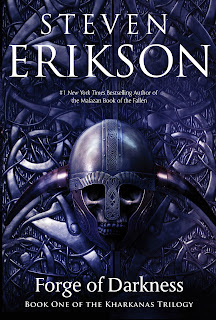 You all know how big a fan I am of Steven Erikson. He single-handedly changed my views on the Fantasy genre, and he has written some of my favorite novels. Ever. When people ask who my favorite authors are, the first one I always say is Steven Erikson.
All that said, I'm a reviewer. I understand why people don't like his work. That's fine. Not everyone reads and likes the same things, and that is how the world of literature should be. But I would be lying if I said it didn't make me a tad disappointed whenever someone says they just couldn't "get into" Erikson's Malazan series. There are so many unbelievable characters in that series, and the stories of the rise and fall of entire civilizations are spectacular.
FORGE OF DARKNESS, the first novel in Erikson's Kharkanas Trilogy, was the novel I hoped would bring in all those readers who wanted a different starting point to Erikson's work. It is a prequel to the Malazan Book of the Fallen 10-novel epic, and it both succeeds and fails.
I'll start with appealing to those of you who, like myself, have read the full Malazan series. Did you ever want to know more about Anomander Rake? How about Silchas Ruin and Andarist? Draconus maybe? Perhaps Caladan Brood? I've always wanted more info on Mother Dark. I'm hardly scratching the surface here, but can you see why the prospect of a novel following all these individuals could be so dang exciting?
Here is the description from Amazon:
It's a conflicted time in Kurald Galain, the realm of Darkness, where
Mother Dark reigns. But this ancient land was once home to many a power.
and even death is not quite eternal. The commoners' great hero, Vatha
Urusander, is being promoted by his followers to take Mother Dark's hand
in marriage, but her Consort, Lord Draconus, stands in the way of such
ambitions. The impending clash sends fissures throughout the realm, and
as the rumors of civil war burn through the masses, an ancient power
emerges from the long dead seas. Caught in the middle of it all are the
First Sons of Darkness, Anomander, Andarist, and Silchas Ruin of the
Purake Hold...
From the instant I opened the book and read the opening, I knew I was reading an Erikson novel. His style is so distinct, and his writing beautiful even when describing the most horrible things. It was interesting to see such a different view-point on the Tiste, and specifically on the Sons of Darkness. Anomander became one of my favorite characters in all of fiction when I first read GARDENS OF THE MOON those many years ago. I couldn't help but feel giddy when he made his first appearance in FORGE OF DARKNESS. The feeling was equally strong when Draconus showed up.
And then we don't really get much of them in the rest of the novel.
Yeah. I kept waiting for the next chapter to get back to those men who would become giants in the Malazan series, but it kept getting postponed by the PoVs of a dozen other characters (who also go on to have roles in the Malazan series). At first, this bugged me--and it is something you should be aware of as a reader--but once I stopped focusing on what I was expecting through preconceived notions of what the book should be about, I was able to focus on what the novel was actually about.
Every story starts somewhere. Much of what makes the Malazan Book of the Fallen awesome has its roots in the Kharkanas Trilogy. So many of the characters in that 10-book epic are so tough, so incredible, and being able to see them in a much younger stage of development was extremely rewarding. I was struck how it served as a form of reverse character development. Many times we got such a limited view of the characters in The Malazan Book of the Fallen, or we saw them at their zenith. Now, finally, we see the decisions that led to the consequences in GARDENS OF THE MOON and beyond.
Now, FORGE OF DARKNESS isn't all roses. While I ended up really liking the side characters, I noticed one thing about all of them that really began bothering me towards the latter portion of the novel. Erikson really likes his characters to have philosophical discussions. In other novels, Erikson would limit this to certain PoVs. Not so here. I swear that every character--man, woman, child, Tiste, horse, Jaghut, soldier, corpse, or dog--took a moment to delve into a deep discussion on random bits of philosophy. I like certain characters to go that route, but not ALL of them. It's like how I often point out how Brandon Sanderson makes all of his characters overly witty in a few of his books. I like it a little bit, but not with everyone. Heck, remember Karsa? There came a point where even he says, "Enough talk. Witness."
Lastly, after the initial cool factor of seeing your favorite characters for the first time, the novel slows WAY down. It's mostly talking, even at the end. We get a few battles, but no "convergence" clashes of epic magnitude. I appreciate the political manipulations that pervade the novel, but there comes a point where the pace needs to be picked up. Hopefully we will see this in book 2.
The end result of all of this is that FORGE OF DARKNESS is an incredible novel for a fan of Erikson's work. I'm that guy. I loved it. But as a reviewer, and as a guy that wants more people to read Erikson's work, I can't help but feel it was a missed opportunity to pull in even more new readers.
FORGE OF DARKNESS is an incredible novel, but my opinion is that you shouldn't start here. You should start with GARDENS OF THE MOON just as before. If you are already a fan, this book is a must-read. And as ever, I look forward to the next Erikson novel.
Recommended Age: 17+
Profanity: More than usual. It can be strong, but not distracting.
Violence: When Erikson cuts loose, it is violent and awesome. It can also be very, very grim and disturbing. This is probably the most personally violent novel he has written.
Sex: Far more than normal. There are frequent mentions of rape, and a couple of characters have a very sexual relationship. It never gets crazy explicit, but it is far more detailed than in any of his previous work.
Pick it up here:
FORGE OF DARKNESS
The Twelve-Fingered Boy
 I enjoyed John Hornor Jacobs' THIS DARK EARTH so much that I had to read more of his work. Fortunately Jacobs has two other published books on shelves - the southern gothic, Lovecraftian horror of SOUTHERN GODS (read the EBR review here), and the YA Horror THE TWELVE-FINGERED BOY. I'm eager to start SOUTHERN GODS but I couldn't pass the opportunity to read a Young Adult book about a kid with twelve fingers that has a form of telekinesis.
Shreveport Cannon has lived a hard life, at fifteen years old he's suffered more than his fair share. He's learned to look out for himself, and he's used his street smarts to keep his skin intact during his stint at Casimir Pulaski Juvenile Detention Center for Boys. When Jack Graves is introduced to the eco-system of Casimir Pulaski things get...weird. Jack has twelve fingers and twelve toes, but that's not the strangest thing about him. When he gets mad or feels threatened Jack explodes with telekinetic force. And there are those that seek to acquire Jack and his ability, nasty customers like the menacing Mr. Quincrux.
THE TWELVE-FINGERED BOY is told in the first person by juvenile delinquent Shreveport "Shreve" Cannon. Shreve's voice is highly unique. He's likable with an edged wisdom that bespeaks his difficult lot in life. For a fifteen year old he's had the majority of his naivety burned away by circumstance but what remains is intelligence and a surprising compassion. Shreve quickly takes to Jack, despite his reluctance to being saddled with fresh blood. Looking back I'm surprised at how little is learned about Jack over the course of the novel. He too, is likable, and the relationship that matures between the two boys is convincing.
It's a relationship that grows and changes as the boys grow and change. Half of the book is spent in Casimir Pulaski, as Shreve helps Jack adjust to life in juvenile correction. Things get much more complicated as Shreve learns about Jack's special ability and Mr. Quincrux is introduced to the equation. Mr. Quincrux is a creepy-bad-dude though perhaps a little shallow on the characterization and slightly cliche. He's dark and mysterious with a (seemingly) malevolent agenda, but never develops beyond that. Eventually Shreve and Jack break out of Casimir Pulaski and the rest of the book is spent fleeing Mr. Quincrux.
This is where things start to get (even more) interesting, as Shreve and Jack learn to survive and test the limits of their powers. Oh, did I not mention? Shreve ends up acquiring a power of his own due to his involvement with Jack and Quincrux. It's cool to follow Shreve and Jack as they learn how to use their abilities. In a lot of ways THE TWELVE-FINGERED BOY is like the indie flick Chronicle, an origin story of a couple not-quite-superheroes. Shreve's telepathy and Jack's telekinesis can be just as dangerous to the user as to the target. Shreve realizes that his telepathy is invasive and wrong but he uses it to provide and protect. Jack's telekinesis on the other hand requires anger to utilize and holding onto that much anger could prove to be damaging.
THE TWELVE-FINGERED BOY is a fast read, packed full of action and humor and a splash of darkness. It's not an average YA novel. Shreve and Jack aren't average YA protagonists. The plot is an effective mashup of Louis Sachar's HOLES and Chronicle. The ending suggests more novels to come, a prospect that I find greatly exciting. I'd love to see how Shreve and Jack progress from here and I need to know what is in Maryland!
Recommended Age: 14+
Language: A few words here and there.
Violence: There's some graphic comic style violence.
Sex: None.
Want it? Buy it here.
Promise of Blood
 I feel bad. I received an ARC of PROMISE OF BLOOD by Brian McClellan several months ago and quickly devoured it. I had every intention of having a review ready to go when the book came out...and then it didn't happen. The problem was I wanted to write something witty and fun about the book but all I kept coming up with was....I liked it. I liked it a lot. And that's really understating it because I really, really did like it. After finishing McClellan's debut I looked him up to check out news for the next book. I looked on Amazon to see what was going on. I even checked on Orbit's blog to see if there was any news about the series. It was a dang good book. I just felt that I should do something more with the review than just, "Yeah, I really liked it."
And that's my bad. Here, Brian has gone out of his way to write a stellar debut novel and I can't get off my lazy butt to write him a review? Shame on me. SHAME ON ME! As a person of integrity I MUST make amends!
Dear Brian,
Dude, my bad. You did your part. You wrote a great book. You had a fun interesting world with stuff in it that I've never seen. You had fantasy in a revolutionary war type setting and I've never read anything like that. You had mages who get powers from gunpowder. You had Gods walking among men, not to mention several other really neat surprises thrown in (I won't spoil them all here--there may be readers watching).
You had fun and interesting characters. I loved Tamas. I mean the book starts out with him killing the king and overthrowing the existing government? What a great opening. It sets up a pace right from the beginning that made me not want to put the book down. Then you throw in a mystery of a dying man's phrase that could have significant meaning to the war--the way the investigator, Adamat handled that one was terrific. Oh and let's not forget Tamas' son, Taniel who is tasked with tracking down and killing a very powerful powder mage (or so we think). And just as I'm beginning to get the sense that revolutionaries = good, and royalty = bad, you throw in Nila--a servant in a former royal house--who has a different view on things. Great stuff!
Reading through the book was a joy. I enjoyed the magic systems and twists and turns of various powers. I also liked the interplay of the stories, specifically how characters would come and go interacting with various point of view characters to give me a greater sense of the whole. Honestly, PROMISE OF BLOOD gave me a very Daniel Abraham/Brandon Sanderson vibe (and if that sentence doesn't give you goosebumps then you must have no soul). I honestly can't give much higher praise than that.
So again Brian, I'm sorry. I dropped the ball on this one. To make it up to you, I'll make you a deal. How about, you send me Advanced Reader Copies of the next two books in the series (as soon as possible please) and I promise to have reviews ready to go the day those books are published. Deal?
Your New Fan,
Shawn of Elitist Book Reviews
Everyone should pick up PROMISE OF BLOOD. Brian McClellan will easily make it to our short-list next year when nominations for the Campbell Award are open. Yes, it really is that good.
Age Recommendation: 16+ for violence and some suggestive stuff
Language: Nothing really to comment on.
Violence: Starts with the king being murdered and there's a massacre in there as well. Not super gory though.
Sex: Referenced and suggested.
Any fan of Daniel Abraham and/or Brandon Sanderson should pick up Brian McClellan's debut. Here's your link:
PROMISE OF BLOOD
A Once Crowded Sky
 I've read comics since I was a kid but I could hardly be called a devoted fan. I've always found it too difficult to keep up with the individual arcs - there were no comic shops nearby and so there were great periods of time where I was out of the loop. Having recently moved to the city it has become easier to get my hands on comics but I much prefer graphic novels as it's a much simpler way to follow the story. Modern comics cost far too much to sample a wide variety of characters and half the pages seem to be filled with advertisements. It's for all these reasons that superhero novels appeal to me so greatly. Currently it's an under-tapped genre and so it's quite exciting when a new author enters the fold. A ONCE CROWDED SKY is Tom King's debut novel - a superhero story with literary sensibilities.
From Amazon: The superheroes of Arcadia City fight a wonderful war and play a wonderful game, forever saving yet another day. However, after sacrificing both their powers and Ultimate, the greatest hero of them all, to defeat the latest apocalypse, these comic book characters are transformed from the marvelous into the mundane. After too many battles won and too many friends lost, The Soldier of Freedom was fine letting all that glory go. But when a new threat blasts through his city, Soldier, as ever, accepts his duty and reenlists in this next war. Without his once amazing abilities, he's forced to seek the help of the one man who walked away, the sole hero who refused to make the sacrifice--PenUltimate, the sidekick of Ultimate, who through his own rejection of the game has become the most powerful man in the world, the only one left who might still, once again, save the day.
A ONCE CROWDED SKY poses an interesting "What If". What happens when superheroes lose their powers and have to adjust to the world the rest of us live in? It flips the whole paradigm on its head. The heroes of Arcadia City are pretty generic, but the masked personas aren't as important as the ordinary people they are when the spandex comes off. Ultimate, PenUltimate, Soldier of Freedom, Star-Knight, and the lot serve established roles - allowing readers to jump right into the story and know who is who without loads of exposition. A ONCE CROWDED SKY is told from a number of perspectives, each chapter divided into "issues" of separate "comics" in a neat layout choice. Outside of the primary protagonists, PenUltimate and Soldier of Freedom, the depth of the characters is rather thin.
PenUltimate (or Pen for short) is the last remaining hero with powers. When all the other heroes gave their power to Ultimate in order to prevent the coming apocalypse, Pen stayed home afraid. Ultimate made the final sacrifice to once again save the day but the heroes were left to adjust to a world without high-speed aerial battles and monstrous villains. For his cowardice the heroes despise Pen, who just wants to live a normal life in the aftermath of final adventure. When a new crisis comes to Arcadia City, Soldier of Freedom finds himself responsible for turning Pen into the hero he was always meant to become.
Pen is the reluctant hero, a sidekick that never asked to fly amongst the protectors of Arcadia. After years of fighting alongside the greatest paragon of them all, Pen set aside the cape in order to be with the woman he loved. He regrets failing to be there when Ultimate needed him most. Soldier of Freedom is the essence of patriotism, stepping up to serve whenever his country has called him to action. He is an old dog, weary of fighting the never-ending battle. The other characters serve to flesh out the primary protagonists and their history while painting a picture of extraordinary people caught by ordinary circumstances. Some of the heroes, such as Star-Knight, take the loss of power better than others.
Still, all eagerly anticipate the day when they can once more play the game. It's an interesting look at motivation, obsession, and coping in a world where you no longer recognize your place. It's also makes for a thoughtful story about heroism and sacrifice. Despite a lack of powers, many of the heroes jump at the opportunity to get back into the game when crisis comes calling - acting in the equivalence of emergency workers. The plot has a number of twists, one of which surprised me and pleased me in equal measure. The hunt for the perpetrator of the "cracks" is lacking, the heroes go about from one disaster to the next without putting much effort into tracking down the cause. I suppose that could be chalked up to the influence of certain comics - detectives, these characters, are not. There is action and violence, though the progression of Pen and Soldier are the main concern. A ONCE CROWDED SKY succeeds as a tale of redemption and loss though the pacing does drag in places, and the ending feels particularly drawn out. I think much of the blame can be placed on King's use of repetition. The technique accomplishes what I believe the author set out for, but it does weigh down the prose in places.
In a lot of ways A ONCE CROWDED SKY is like a mash-up between Alan Moore's WATCHMEN and John Scalzi's REDSHIRTS. It's not nearly as dark as WATCHMEN, nor quite so self-aware as REDSHIRTS but it does inhabit a comfortable middle ground between the two. It's a very contemporary story with roots in Dante Alighieri's THE PARADISO. I'd also be remiss not to mention the incredible illustrations courtesy of Tom Fowler. These beautiful black and white comic panels add a whole extra level of enjoyment to the story, serving as a reminder of the pulp traditions of this literary debut.
"Another battle won. Well done. Well done."
Recommended Age: 16+
Language: Plenty of foul language.
Violence: Yes, some of it graphic.
Sex: None.
Want it? Get it here.
Energized
 You think $4.00 gas is bad? Try five times that. Try rationing. That's what life could be like starting in about two years with Edward M. Lerner's Crudustrophe in ENERGIZED.
Lerner poses a big "What If?" What if suddenly and catastrophically all of the Middle East's oil supply was snuffed out? What would it be like living in a world where energy was in short supply? Would alternative energy be enough to fill the gaps?
And what if there were some people who actually liked it that way?
The story in ENERGIZED mostly revolves around Marcus Judson, NASA engineer on the Powersat One--an enormous solar power satellite that is in constant view of the sun, and then beams that energy to Earth in the form of microwaves, where it's then distributed to the already strained U.S. power grid. Marcus is just trying to do his job convincing people that, yes, they do want a giant series of solar panels in the sky; and, no, the microwaves beamed down aren't going to fry you. We hope.
Unfortunately, there are some called Resetters who believe it would be better to just abandon the desperation of alternative energy and go back to the good ol' pre-industrial days. Such as Dillon Russo, whose venture capitalist company on the outside appears to want to help new businesses with alternative energy, but secretly hides a Resetter and Gaia Mother Earth theology.
Then there's Valerie, the astronomer, whose space telescope is pretty worthless with a huge powersat in the way, and calls NASA to complain. They send Marcus. Queue love story. There are a few other interesting PoV characters, but those three are the ones to really pay attention to. And for the most part Lerner does pretty well with them. They're consistent and their motives are pretty obvious. But they aren't the kind of characters you'll grow to love. Well, maybe a little affectionate.
Lerner sets up the story pretty well, even if the first half of the novel feels rather slow, and the story is heavily enough foreshadowed that very little came as a surprise. I had a hard time getting through the character positioning as well as all the science mumbo jumbo--so much work to get everything just right for the climax. Once we hit about 2/3 of the way, the story finally takes off and everything that went before begins to come together.
While the characters and the plot were serviceable, they lacked pizazz. And yet I still liked what Lerner did with the story. I love the "What If" ideas in the book, how he presents them, and works around them to make a fascinating thriller of a story. Really, it's the Powersat One that's the main character of the book. Everything revolves around it, how it works, what it's capable of, the problems it presents, and the sacrifices people make to either destroy or save it. ENERGIZED is worth reading if you like exploring the ideas and the "What If."
Recommended Age: 18+ for comprehension
Language: A handful
Violence: References to mass killings, and some on-screen deaths, but not much blood
Sex: Referenced only
Sound like ENERGIZED is for you? Find it here:
ENERGIZED
I Travel By Night
 If you don't know by now, let me be clear: I love Subterranean Press. Simply put, the quality of the books they put out are nothing short of amazing. From the art to the actual materials used to make the book, the production quality never fails to impress. Additionally, Subterranean Press is the publisher for all of Robert McCammon's novels these days. Every McCammon story I have read thus far has been terrific, and he has easily become one of my favorite authors. So when Subterranean Press announced new novella from McCammon, I begged and pleaded for an ARC of it.
I TRAVEL BY NIGHT is a vampire story. I'm tired of vampires. They don't hold much interest for me these days. I blame it on the over-saturation of the market with the sexy, glittery variety. But if there is one author I trust with the classic Horror monster archetypes, it is Robert McCammon.
The short version is that I TRAVEL BY NIGHT is classic McCammon, and absolutely incredible.
The story begins with an introduction to the character Trevor Lawson. He was given the curse of vampirism on a battlefield during the Civil War, and ever since has been trying to track down the vampire queen that turned him. If he can find her, he may be able to reverse his affliction and become mortal again. Until then, Lawson takes whatever jobs he can to help the less fortunate.
The first thing I noticed was how the beginning of the novel has a rambling cadence to the narrative. It felt like I was lounging comfortably in front of a blazing fireplace while McCammon sat across from me relating the story. That narration style continues until Lawson accepts a job that could potentially put him back on the trail of the vampire that turned him. Then the story is a pure Horror and Adventure thrill-ride.
Since this novella is on the short side, I hesitate to describe the other characters Lawson encounters in I TRAVEL BY NIGHT. You would be better served discovering them without any preconceived impressions acquired from me. I will say that each side character has a brief back-story that, while quick and direct, made me instantly like them. Lawson himself is a sympathetic character that is the classic good-guy holding back the monster within himself. If you have read any of McCammon's other works, you know how effortlessly he writers those types of characters, and Trevor Lawson is no exception.
Very quickly into the story, McCammon shows us how vampires should be. They are monsters, plain and simple. The older they are, the more monstrous they become. This is why I know I can always trust McCammon to write any kind of monster. He just gets it.
The best part of I TRAVEL BY NIGHT, for me, was the ending. This is Horror, and as such should have some hopelessness to end the story. There is a small measure of success, but it is mixed with an equal share of failure and worry for the future. The instant I finished the novel, I immediately contacted McCammon begging for more.
I TRAVEL BY NIGHT is short. For some, too short. It is the type of story that you will want to read in one sitting. So the question is, should you spend Hardcover money on a story that spans 150 pages? I did. In fact, I bought a regular Hardcover of the novel than also purchased a signed and numbered edition as well. Why? Because I loved I TRAVEL BY NIGHT. Because I hope that if we all support this novella, McCammon will either turn this into a huge novel or write more novellas featuring the vampire Trevor Lawson.
I TRAVEL BY NIGHT showcases Robert McCammon's skill at bringing Historical Horror to life. It is an effortless read crafted with an expert storyteller's touch. If you are a fan of McCammon's work specifically, or just a fan of Horror, you should buy a copy of I TRAVEL BY NIGHT.
Recommended Age: 16+
Profanity: You know, I don't recall any. I'm sure there was some, because there always is in McCammon's work. We'll say it is on the same level as his Matthew Corbett series.
Violence: It's a vampire hunting vampires. Though the length of the story somewhat prohibits the number of violent scenes that could be included, it still gets pretty awesomely bloody.
Sex: Nope.
Here are your links to buy the novel from either Amazon or Subterranean Press - I personally advocate buying directly from Subterranean Press as their shipping methods are some of the best anywhere, and I just think they are a group of awesome people:
Amazon: I TRAVEL BY NIGHT
Subterranean Press: I TRAVEL BY NIGHT
Also, now is a great time to get McCammon's latest Matthew Corbett novel, THE PROVIDENCE RIDER. It is absolutely terrific, and an amazing price:
Amazon: THE PROVIDENCE RIDER
Subterranean Press: THE PROVIDENCE RIDER
The Skybound Sea
 When endeavoring to attract a new
lover, one cannot begin to understate the dignified merits of beauty, grace,
and poise; and yet nothing else, I have found, will draw undivided attention to
your person more quickly than a good, swift punch to the face. Repetition
encouraged.
Sam Sykes's debut novel, TOME
OF THE UNDERGATES, was nothing, if not exactly just such an
attention-clenching assault on my psyche (read the review here). Through that book, I was ripped from
the funk of my heretofore meager existence, dragged wholesale through the
thrilling chaos of true adventure, and then left to wallow in the self-pity and
dripping mucus of what detritus remained to me. It was an experience that I did
not think that I would soon forget. And I didn't, until I read this novel and
was hit so hard by it that I lost the ability to retain such fond memories of
any other such impactful novel.
THE
SKYBOUND SEA was easily one of my most anticipated sequels to read.
Even after the relatively underwhelming BLACK
HALO, I could see nothing but rampant chaos and giddy carnage for Lenk and
his dear friends (read the review of that novel here). The last novel left part of them floundering in the sea in
search of an invisible island, and the others wandering around the bone-covered
and netherling-infested island they'd found at the end of TOME, and all of them
having a date with the devil during an apocalyptic world-ending visit to the
island of the Shen. Ohmigosh, this book was fun.
The opening chapter nearly sent
me into fits. Super mega action, caged behemoth-god rising from the depths of
the ocean, seagull-Omens chanting salvation, hoardes of frogmen streaming
through the streets, and one lone ex-priest wandering in search of a young
girl. Just whoa. If there was ever a way to start a book this book, or any book
for that matter, this was it. But was SEA going to be another action-fest, or
would it drop off and get too detailed on me? Thankfully, the thing that
was most impressive about SEA was how Sykes took what he'd learned from the
first two books of the series and combined them to make this one. Where TOME
was “action, mockery, action”, and HALO was “breathe, explore, breathe”, SEA
was something on the order of “action, explore, learn”. The balance between
action and story development and character planning sessions and introspection,
all which seemed very skewed and bunched up until this point, was very well
done.
All of the character development
that Sykes has done up until now played major roles in this book as well, and
made this journey all the better. We learn more about Denaos's background, and
oh is it ouchy. Kataria's inner turmoil concerning her people and her
relationship with Lenk (a filthy, disease-tastic human of all things) made for
some serious good reading. The scene where Gariath meets the Green Shict (Shict
on steroids) was awesome-tastic. I laughed for days after reading it. I still
laugh about it. Gariath has some killer fight scenes in this one. Oh,
man. That massive sea serpent? Woo-hoo! His time for contemplation is over, and
he just starts wailing on stuff. Lenk finally finds the voices in his head.
Really great ideas all, and well worth the investment.
There were so many cool parts of
this book that I can't begin to start enumerating them, and Sykes does such a
good job of writing that clarity was never an issue. The balance between action
and breathing/exploring made for great pacing. It never seemed to lag to me,
and things kept moving toward a climax that was obvious (Kraken Queen
wrastlin', anyone?) but by no stretch of the imagination conventional. Sykes
just kept pulling out punch after punch too. Forget the fact that this is
supposed to be a trilogy. Last book?Nah. Bah. Take this. POW! And
here's another. WHACK! And now a left hook. BANG! Guy just doesn't stop.
On the whole, I think this series
could be seriously helped by reading it all together. I know that's probably a
big commitment for some--it's gotta be like 1500 pages or something--but I
really think the story would benefit from doing so. Because, whereas your
typical literary offering will end before the climax of the story ever happens,
this series is nothing but climax. Everything leading up to the events that
happen in these three books has already occurred, and this is the massive clash
of chaos that ensues as a result.
Kind of makes the series as a
whole a kind-of “post-literary” story, in a way. Humph. I like
that. In fact, I might just use that somewhere else.
I honestly can't say enough good
about Sam Sykes. He is one of the elite few that I consider to be a favorite
author of mine. He can write. He can spin a tale. He can nail a character to
the wall with impunity. I can't wait to see what this guy comes up with next.
Will it be more story of Lenk and his “trusty” companions? Given the ending of
THE SKYBOUND SEA, that'd be entirely possible. Or perhaps it'll be something
new? Honestly, it mattereth not. Sign me up, kimosabe. Cause I'm sold.
Recommended Age:18+
Sex: One scene that includes detail on every body part but the
necessary few
Violence: Ridiculously violent and gory but none of it gets
distracting
Profanity: Significantly more than in either of the previous
books, but still quite tame and infrequent.
Here are your link to buy the
novels in this series:
TOME OF THE UNDERGATES
BLACK HALO
THE SKYBOUND SEA
Mage's Blood
 So Steve sends me this huge book, almost 700 pages long, that looks like yet another epic fantasy wannabe. Steve has sent me lemons before, so I started MAGE'S BLOOD a little jaded. I've read a lot of epic fantasy, and I was concerned this one would end up a lemon.
The first thing you notice will be the obvious parallels in earth geography and naming conventions (shihad=jihad, Hebusalim=Jerusalem, etc) and similarities in religions, races, and cultures. I thought to myself, this guy is lazy, can't even be original. Then you'll notice that there's a couple of simple infodumps, but they're short: the student mage reciting lessons or fathers telling children about history. While the prose flows well, it's nothing particularly fancy, and there's a big learning curve with the jargon/names. You have to push through the first 150 pages of set-up.
Turns out, it takes that many pages for David Hair to get his story going. And here I am, mere days after starting it, having been yanked through the rest of the book in a frenzy of magic, love, lies, blood, and politics.
Every dozen years the seas recede enough to reveal the Leviathan Bridge--a 300 mile land bridge created by mages to join the east and west continents. The intent was altruistic: a way to encourage trade and relations between the people. Unfortunately, the people of the west decided to use the 24-month period to conquer the heathen in the name of their god, and for the past two moontides crusaded across the east, plundering and killing. At the start of MAGE'S BLOOD, the next moontide is mere months away, with the expectation that the horrors will happen all over again.
Elena is an undercover spy, acting as bodyguard for the royal children of Jarvon. She's grown to love them and her new home, so contemplates leaving the life of a spy and becoming her own woman. But unbeknownst to her, her boss Gyle plans to have her kill the children she's been protecting.
Ramita is in love with Kazim, and they're engaged to be married. But one day she arrives home to find, to her horror, that her father has promised her to another man who is wealthy and powerful, the greatest mage in the known world: Antonin Meiros.
Alaron is one-quarter mage, and his rich aunt Elena (yes that one) is paying his way through mage school. But not being pure-blooded mage makes him persona non grata and the target of ridicule. Graduation is coming up, but before that he must face weeks of grueling tests, including defending his controversial senior thesis.
To be honest, setting all that up in 150 pages, for what will ultimately be a four-book series, is actually pretty good. Hair's prose may not be fancy, but it's smooth and crisp, and carries you along at a good clip. It can sometimes get too crowded with all the place names, those take time to learn, but he tries to help with the learning curve by using semi-familiar naming and geography. The action scenes are creative, especially when magic is involved--he tries to show what mages can really do and the often terrible consequences.
Elena, Ramita, and Alaron are the three central characters, and Hair draws them well, the main story revolving around them and what they do; I really appreciated his consistency switching between them, which shows Hair's excellent control of unfolding story and characterization. Hair also does well with the secondary characters, their PoV scenes don't clutter the narrative, yet include as much detail as the main characters. He's created a fascinating and diverse group of people that I understand despite their cultural differences.
I'm still a little ambivalent about how he handles the setting. As a fan of Urban Fantasy, I see the usefulness in using an existing culture and place. This means an author can focus on the story and characters, and as a result, the pace of a book can more quickly engage the reader. Then again, I love the strange and unique settings in recent books like THE WAY OF KINGS or THE BLINDING KNIFE. Not that MAGE'S BLOOD isn't without its own setting development--Hair spends the most time on the magic, how it works, where it came from, and the culture surrounding it. It gets a little tedious at times, but at least I don't have to complain about not understanding. Another positive is that while the geography and cultures are similar to ours, he doesn't stint on describing clothing, the races, their cultures and behaviors, as well as the landscapes and politics of each.
So: 150 pages of set-up; 400 pages of unfolding intrigue, traveling, mysteries, the occasional action scene; then with about 150 left to go BAM, Hair punches out a quick succession of events that completely twist everything that came before. Hair isn't afraid to take the story where it needs to go; the results are hard to swallow because by the end I became attached to these characters and I didn't want to see them suffer. The end isn't what I thought it would be. It was better. While it ties off the storylines of book one, it sets up so much potential for what's to follow.
There's much more I could cover as I try to explain this book, there are so many great details of character, setting, and story--unfortunately there isn't enough room here. This is the kind of book for those who like epic fantasy, but find Malazan inaccessible (?!?!) or Game of Thrones too gritty. You may find yourself as engrossed as I was.
Recommended Age: 18+ for content
Language: There's some, the worst of it replaced with a made-up word
Violence: Some, and when there is violence it's bloody
Sex: Lots of the graphic variety; references can get crass
MAGE'S BLOOD doesn't release in the U.S. until September 13th (here it is on Amazon if you want to preorder), but has been available on Book Depository (free shipping worldwide!) for the last year, as it was originally published in the U.K.
MAGE'S BLOOD is the first book of The Moontide Quartet.
This Dark Earth
 If there is one thing you Elitist Book Reviews followers are aware of about me, it has got to be the number of things I don't like in fiction--and how good authors can subvert these preferences and make me eat crow. So in another installment of "Things Nick Hates" I present you (drumroll please) zombies. I'm sorry, but they bore me. I used to like them and I still hold onto the belief that THE ZOMBIE SURVIVAL GUIDE and WORLD WAR Z are some of my favorite books of all time. Still, there is a saturation of zombies (sort of like the over abundance of vampires a couple years ago) and I find it tiring. There are only so many things you can do with zombies and it would take something different to interest me in another piece of undead fiction. THIS DARK EARTH by John Hornor Jacobs is that "something different" and it served to remind me how much I used to love the sub-genre.
The apocalypse has come and gone, ushered in by a zombie outbreak and attempted nuclear containment. The remnants of humanity live in a pre-industrial society, hunkered down in the ad-hoc fortress of Bridge City. The city is near impervious to the zeds, a marvel of ingenuity and medieval siege mastery. Humans though, have a capacity for evil that far exceeds the mindless, flesh eating, undead. An army of slavers has Bridge City in its sights and the survival of civilization falls to Gus, the young man that designed the very fortifications that have kept the wild at bay for so long.
Do you know how THIS DARK EARTH manages to be both a zombie novel and a book that I love? It's a zombie novel but it's not about zombies. Don't get me wrong, there are loads of zombies within the pages. Tens of thousands of zombies. There's plenty of bludgeoning and brain-destroying, with buckets of putrid gore and viscera. But that's not the focus of the novel. THIS DARK EARTH goes to show that even in the wake of global catastrophe, even with the cannibal dead roaming the earth, the living can still manage to take the whole evil cake. THIS DARK EARTH is a story of family, community, and survival.
The three main characters are Lucy, her son Gus, and Jim (aka
Knock-Out). Lucy is cold and clinical. She is a brilliant doctor, with a
highly analytical mind that leaves her detached from humanity. She is
not delicate in the least. Lucy is almost robotic, but that's not to say
she is stiff or thin as a character. When she exhibits a rare moment of
tenderness it is touching. Knock-Out is a gentle giant, he was a
trucker before the end of the world and becomes a loyal companion after.
He is a genuinely kindhearted man that serves as the adhesive for the
others. He's the sidekick to Lucy's superhero. And then we have Gus, the
brilliant child that designed Bridge City who grows into the hardened
man that must lead the free and the living. Gus shares much in common
with his mother, his intense personality is only compounded by the
trials of growing up in this post-apocalyptic world. He is a strange
young man, extremely intellectual and still inexperienced in many ways.
He has a lot to learn before he can become humanity's savior.
There
are other characters, three of the chapters are told from their
perspectives, but they serve primarily to forward the story of Lucy,
Gus, and Knock-Out. In this way THIS DARK EARTH felt like a collection
of short stories based around a central thread. It's not, but the
shifting narrative (between first person, third person, and one chapter
told in journal format) gives an interesting, multifaceted view of
proceedings. The first half of the novel is a somewhat standard
post-apocalyptic/zombie affair. One of the blurbs on the back of the
book likens THIS DARK EARTH to Cormac McCarthy's THE ROAD and WORLD WAR Z
by Max Brooks. The first part of the book definitely relates to THE
ROAD, as Lucy and Knock-Out scramble to survive in a world only recently
turned upside down. It's at the halfway mark that I became fully
absorbed in the read. It is here that we are introduced to Bridge City
and the looming threat of the slaver army. From here Gus and the city
council race to find a way to stop the army's progress and defend all
that they have built. This is where the novel takes on a bit of the
atmosphere of WORLD WAR Z, but really I couldn't help but think of the
CBS action/drama Jericho. I loved the creation of Bridge City and the
society that the survivors had established in the aftermath of the
outbreak and nuclear fallout.
THIS DARK EARTH is a dark book (go
figure). It displays the worst that mankind has to offer, from rape to
slavery and greed. There is heavy violence (mainly zombie slaying but
some living on living action too) as well as a grisly torture. Despite
all this there is also a silver lining of hope. Despite all the death
and despair it shows that we can survive and adapt as a species - we can
look out for our own.
Recommended Age: 17+
Language: You betcha.
Violence: Shooting, bludgeoning, burning, and a painful torture/crucifixion.
Sex: Sex and sex talk.
Want it? Here's you link:
THIS DARK EARTH

 Posts


